
Introduction to Agentic AI
What is agentic AI, and how is it different from a chatbot or classic automation? A plain-English introduction to how AI agents work, where they help businesses today, the risks to manage and a simple roadmap for adopting them safely.
Brayan K. Jayawardhana · · 8 min read
Agentic AI is one of the most talked-about ideas in technology, and one of the most confusing. Ask five vendors what an AI agent is and you may get five different answers. So what is agentic AI, really? In short, it is AI that does not just answer questions but works towards a goal: it plans steps, uses tools such as your business software, checks the results and asks a person when it should. This introduction explains how agents work, where they are useful today, what can go wrong and how to start safely.
What is agentic AI?
Agentic AI describes systems built around a large language model (LLM) that can act on your behalf. You give the agent a goal, such as “prepare a summary of overdue invoices and draft reminder emails”, and it works out the steps, gathers the information it needs, takes actions through approved tools and reports back.
The word “agentic” refers to this agency: the ability to decide what to do next within limits you set. A good agent is not a free-roaming robot. It is closer to a capable assistant with a clear job description, a defined set of tools and a supervisor.
AI agents vs chatbots vs classic automation
It helps to compare agents with two things most businesses already know.
Chatbots
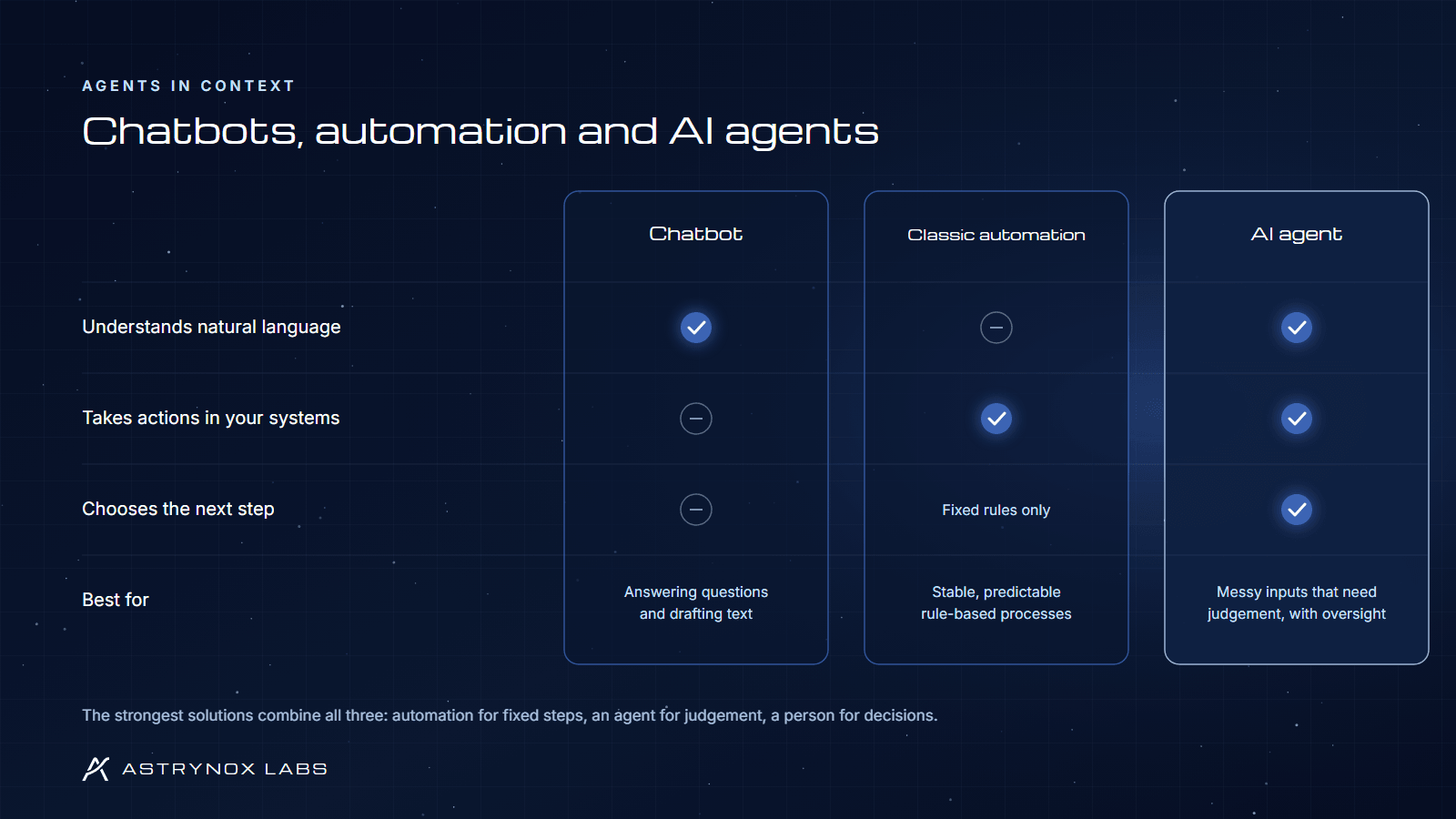
A traditional chatbot answers questions in a conversation. Even modern LLM chatbots mostly respond to the message in front of them. They can explain, summarise and draft, but on their own they usually cannot look up your order system, update a record or follow a task through to the end.
Classic automation
Rule-based automation, including workflow tools and robotic process automation (RPA), follows fixed steps: when this happens, do that. It is fast, cheap and predictable, which makes it ideal for stable, well-defined processes. It struggles when inputs are messy, such as free-text emails, scanned documents or requests that need judgement.
AI agents
Agents sit between the two. Like a chatbot, they understand natural language. Like automation, they take actions in real systems. What they add is the ability to choose the next step based on what they find. In practice, the best solutions often combine all three: fixed automation for predictable steps, an agent for the parts that need reasoning, and a person for the decisions that matter.
How AI agents work
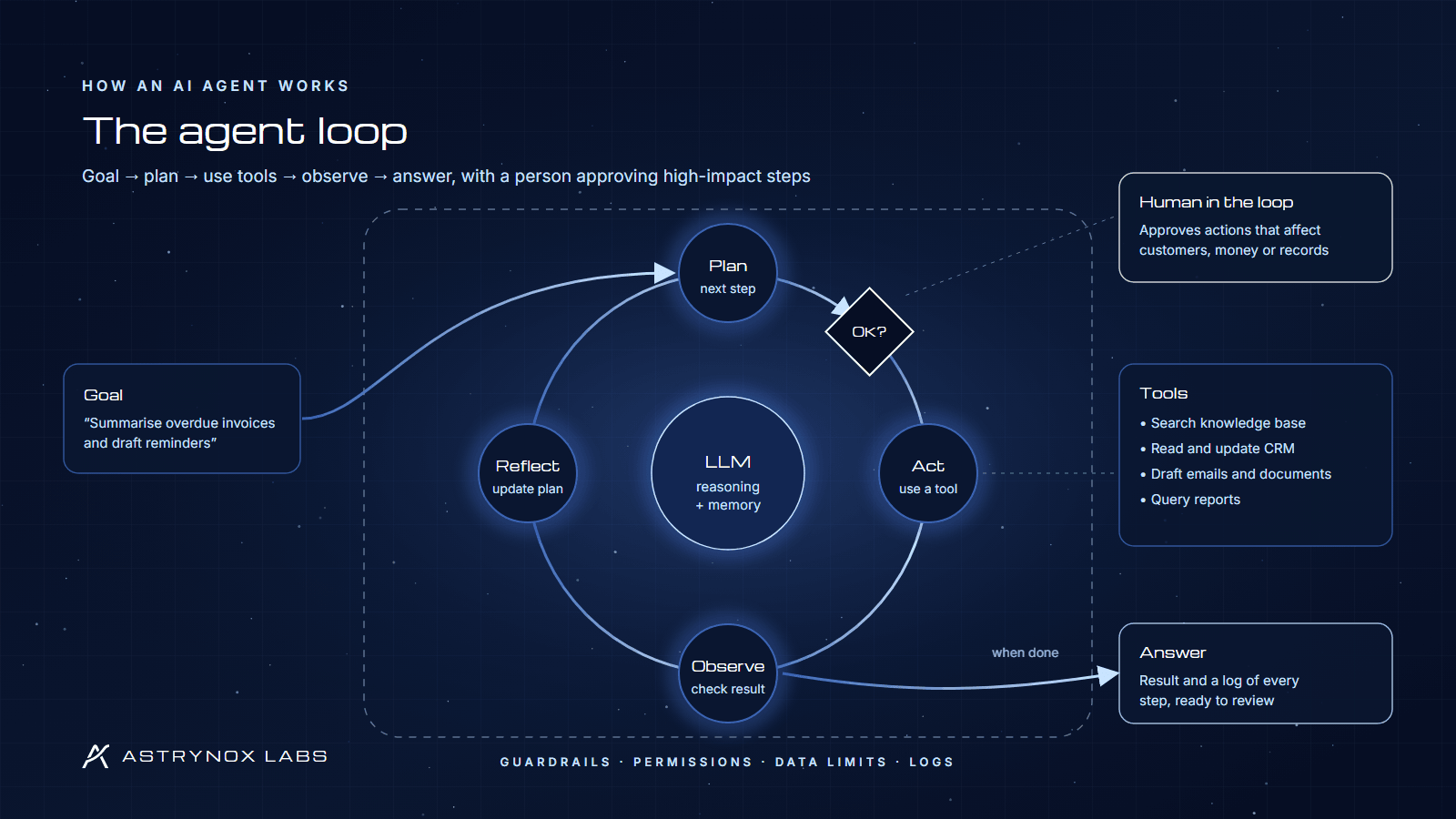
Under the hood, most agents follow a simple loop: understand the goal, plan, use a tool, observe the result and repeat until the job is done or a person needs to step in. Six building blocks make that loop work.
1. Reasoning with a language model
The LLM is the agent's reasoning engine. It reads the goal, its instructions and the information gathered so far, and decides what to do next. Its quality depends heavily on clear instructions and good context.
2. Tools and function calling
Tools are what let an agent act. Through function calling, the model requests a specific, predefined action, such as searching a knowledge base, reading a spreadsheet, querying a CRM or creating a draft email. Your software runs the action and returns the result. An agent can only do what its tools allow, which makes tool design one of the most important safety levers. Open standards such as the Model Context Protocol (MCP) make it easier to connect agents to business systems in a consistent way.
3. Memory
Short-term memory holds the current task: what has been tried and what was found. Long-term memory may store useful facts, past decisions or preferences, often in a database or a searchable index of your documents. Retrieving relevant documents before answering, often called retrieval-augmented generation (RAG), grounds the agent in your own information rather than general knowledge.
4. Planning
For multi-step goals, the agent breaks the work into smaller steps, carries them out and adjusts the plan when a step fails or new information appears. Simple agents decide one step at a time; more complex ones write an explicit plan first and check progress against it.
5. Guardrails
Guardrails keep the agent inside safe limits: which tools it may use, which data it may see, how much it may spend, what it must never do, and checks on what goes in and what comes out. Good guardrails are enforced by the system around the model, not just written into its instructions.
6. Human in the loop
For actions that matter, such as sending an email to a client, issuing a refund or changing a record, the agent pauses and asks a person to approve. As trust builds and results are measured, some approvals can be relaxed. Others should stay in place for good.
A useful way to think about it: the model provides judgement, the tools provide reach, and the guardrails and people provide control.
Practical business use cases
Agentic AI is most valuable where work is repetitive but not perfectly predictable. Common starting points include:
Support triage. Reading incoming emails or tickets, identifying the topic and urgency, pulling up the customer's history, drafting a reply and routing anything complex to the right person.
Document processing. Extracting details from invoices, purchase orders, contracts or forms, checking them against your records and flagging mismatches for review.
Sales operations. Researching leads, keeping CRM records complete, drafting personalised follow-ups and preparing meeting summaries, so salespeople spend more time with customers.
Internal knowledge assistants. Answering staff questions from your policies, manuals and past projects, with links to the source so every answer can be checked.
Reporting. Gathering figures from several systems, writing a weekly summary in plain language and highlighting anything unusual for a manager to look at.
In each case, the agent handles the first pass and the routine steps, while people keep responsibility for the outcome.
Risks, and how to adopt agentic AI safely
Agents are useful because they can act, and that is exactly why they need care. The main risks are well understood:
Confident mistakes. Language models can produce plausible but wrong output, so important results need checks.
Too much access. An agent with broad permissions can do broad damage if it misunderstands a task or is manipulated.
Prompt injection. Instructions hidden in emails, web pages or documents can try to redirect an agent away from its task.
Data protection. Sending personal or confidential data to external services must respect your policies and the laws in the markets you serve.
Unclear value. Without a baseline, it is hard to tell whether an agent saves time or simply moves work around.
Principles for safe adoption
Start small. Pick one well-defined process with clear inputs and a measurable outcome.
Measure. Record how long the task takes and how often it goes wrong today, then compare honestly.
Govern your data. Decide which data the agent may see, where it is processed and how long it is kept.
Limit the tools. Give the agent the narrowest permissions that do the job, with read-only access wherever possible.
Keep humans in control. Require approval for actions that affect customers, money or records, and keep a log of everything the agent does.
A simple roadmap for adopting AI agents
Identify. List repetitive tasks that take up time, and choose one where mistakes are easy to spot and fix.
Prototype. Build a small agent on your real data in a safe environment, with a person reviewing every output.
Pilot. Run it alongside the existing process for a few weeks and measure time saved, quality and the unusual cases it struggles with.
Integrate. Connect it properly to your systems, add monitoring, logs and approval steps, and train the team that will use it.
Scale. Relax approvals only where results justify it, then apply what you learned to the next process.
Each step should earn the next. If a pilot does not show clear value, that is a useful result too, and far cheaper to learn early than after a large rollout.
Conclusion
Agentic AI is not magic, and it is more than a better chatbot. It is a practical way to combine language models with your business tools, so that routine work gets done faster while people stay in charge of the decisions that matter. The businesses that benefit most will be those that start with a clear problem, measure the results and build trust step by step.
At Astrynox Labs, we design and build AI agents that work inside real business systems, safely and measurably. If you are curious where agentic AI could help your team, take a look at our AI & Agentic Automation service, or get in touch for a short, no-pressure conversation.
Frequently asked questions
- What is agentic AI in simple terms?
- Agentic AI is AI that works towards a goal instead of only answering a question. It plans the steps, uses approved tools such as your business software, checks the results and asks a person to approve important actions.
- What is the difference between an AI agent and a chatbot?
- A chatbot mainly answers the message in front of it. An AI agent can take actions in real systems, such as looking up a record, drafting a document or updating a ticket, and it decides the next step based on what it finds.
- Is agentic AI safe to use in a business?
- It can be, when it is designed with care. Give agents the narrowest permissions they need, control which data they can see, log everything they do and require human approval for actions that affect customers, money or records.
- Do we need a lot of data to start using AI agents?
- No. Most business agents use existing language models rather than training new ones. What they need is access to the right information for the task, such as your documents, policies or records, organised well enough for the agent to search.
- Will AI agents replace our staff?
- In most businesses, agents take over repetitive first-pass work such as sorting, extracting and drafting, so people can spend more time on judgement, customers and decisions. People stay responsible for the outcome.
- How should a business start with agentic AI?
- Pick one well-defined, repetitive process where mistakes are easy to catch. Measure how it works today, build a small prototype on real data with a person reviewing every output, run a short pilot and expand only when the results justify it.
Related service: AI & Agentic Automation
Want to talk about this?
Tell us where you are today. We'll map where technology can take you.