
The Evolution of Software Engineering Over the Last 10 Years
From containers and DevOps to TypeScript, serverless and AI coding agents: the software engineering trends that reshaped how products were built between 2016 and 2026, and what they mean when you choose a software partner.
Brayan K. Jayawardhana · · 9 min read

Ten years is a long time in software. In 2016, many businesses still ran applications on servers they could point to, released updates a few times a year and treated security as a final check before launch. By 2026, most new software is built on cloud platforms, shipped in small changes many times a week, tested automatically and written with help from AI. This article walks through the software engineering trends that drove that change, explains which ones lasted, and closes with what they mean for a business choosing a software partner today.
Software engineering trends at a glance
The decade did not move in a straight line. Some ideas were adopted widely, some were overused and then corrected, and a few changed how teams work every day. The biggest shifts fall into five groups:
How software runs: cloud-native platforms, containers, Kubernetes, serverless and the edge.
How it is shipped: DevOps, CI/CD, automated testing and, later, platform engineering.
How it is structured: the rise of microservices and the swing back to modular monoliths.
How it is written: TypeScript, modern web frameworks, open source and AI assistants.
How teams work: security that starts early, supply chain care and remote, async collaboration.
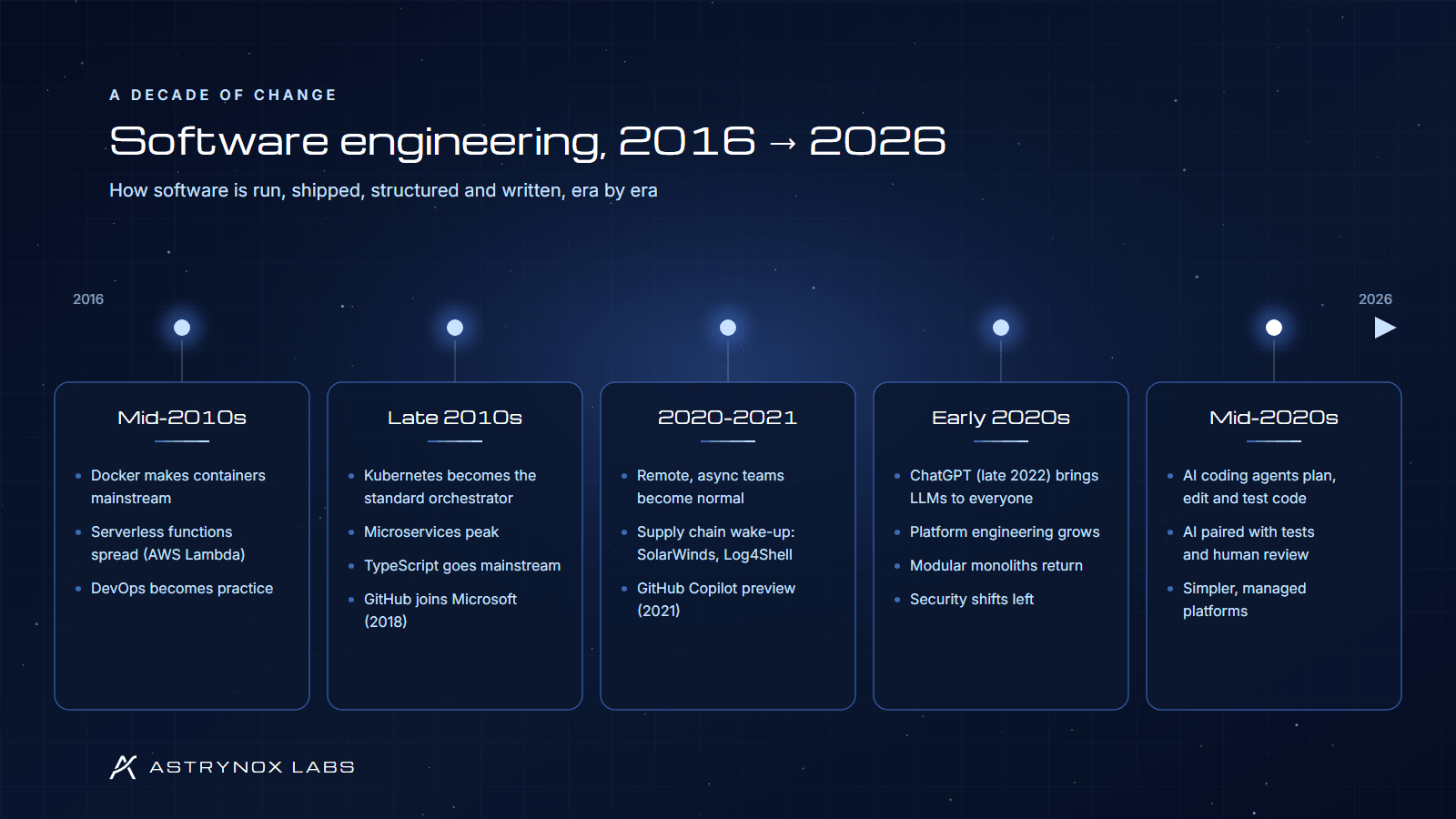
Cloud-native, containers and Kubernetes
In the mid-2010s, containers moved from a niche technique to the standard way to package software. Docker made it simple to bundle an application with everything it needs, so it runs the same way on a laptop, a test server and production. That removed a whole class of “it works on my machine” problems.
Running many containers reliably needed an orchestrator. Kubernetes, originally developed at Google and later donated to the Cloud Native Computing Foundation, became the de facto standard by the late 2010s, and every major cloud provider now offers a managed version.
The lesson of the decade is balance. Kubernetes is powerful, but it carries real operating cost. Many small and mid-sized products are better served by managed platforms that run containers for you, which is why simple, “boring” hosting choices became popular again in the 2020s.
From DevOps to platform engineering
DevOps started as a culture change: developers and operations teams sharing responsibility for software in production. Over the decade it became a set of everyday practices, including infrastructure as code, automated deployments and monitoring that developers actually look at.
As systems grew, expecting every developer to master cloud networking, pipelines and security became a burden. Platform engineering gained momentum in the early 2020s as the answer. A small platform team builds an internal “paved road” of templates, pipelines and self-service tools, so product teams can ship safely without becoming infrastructure experts.
Our view: DevOps made teams responsible for running what they build. Platform engineering makes that responsibility manageable.
Microservices and the swing back to modular monoliths
Microservices were one of the defining ideas of the late 2010s. Splitting an application into small, independently deployed services promised faster teams and easier scaling, and it worked well for large organisations with many teams.
For smaller teams, the costs often outweighed the benefits: network calls instead of function calls, data spread across services, harder debugging and more infrastructure to run. By the early 2020s a correction was under way, and several well-known engineering teams wrote publicly about consolidating services again.
The modular monolith became the sensible default for many products: one deployable application with clear internal boundaries, which can be split later if one part genuinely needs to scale or change on its own.
How to choose an architecture today
Start with a well-structured modular monolith unless there is a clear reason not to.
Split out a service when it has a different scaling profile, release cycle or owning team.
Judge an architecture by how easily you can change it, not by how modern it sounds.
TypeScript and the modern web
JavaScript runs nearly every website, but large JavaScript codebases were hard to maintain. TypeScript, released by Microsoft in 2012, adds types that catch mistakes before code runs. Over the late 2010s it moved from an optional extra to the default choice for many serious web projects, and popular frameworks began to ship with first-class TypeScript support.
The web platform matured too. Component-based libraries such as React became mainstream, and full-stack frameworks such as Next.js blurred the line between front end and back end. Server-side rendering returned for speed and search visibility, and build tools became dramatically faster. For businesses, the result is web applications that feel like native apps while still being easy to find on Google.
Serverless and the edge
Serverless computing, popularised by AWS Lambda in the mid-2010s, lets teams run code without managing servers at all. You pay for what runs, and the platform scales automatically. It suits event-driven tasks, APIs with uneven traffic and background jobs.
Edge computing pushed the idea further by running code in data centres close to users around the world. Cached pages and lightweight functions at the edge make websites faster for visitors whether they are in Colombo, London or Sydney. The trade-offs are cold starts, platform limits and some lock-in, so serverless works best as one tool among several rather than a rule for everything.
CI/CD and a real testing culture
Continuous integration and continuous delivery (CI/CD) turned releases from stressful events into routine. Every change is built, tested and checked automatically, and often deployed within minutes. Hosted services such as GitHub Actions made capable pipelines available to teams of any size.
Testing culture matured alongside it. Unit tests, integration tests against real databases and end-to-end browser tests with tools such as Playwright and Cypress became a normal part of delivery rather than an optional extra. Feature flags, preview environments and quick rollbacks made it safe to release small changes often.
Security shifts left, and the supply chain matters
Security used to be a final gate before launch. Over the decade it “shifted left” into design, code review and the build pipeline. Dependency scanning, secret detection and static analysis now run automatically on every change in well-run teams.
Modern applications depend on hundreds of open-source packages. High-profile incidents in the early 2020s, such as the SolarWinds compromise and the Log4Shell vulnerability, showed how one weak link can affect thousands of organisations. Software supply chain security became a priority, with practices such as pinned dependencies, software bills of materials (SBOMs), signed builds and regular audits.
Open source becomes the foundation
Open source moved from the edge of the industry to its centre. Operating systems, databases, frameworks and developer tools are now overwhelmingly open source, and large technology companies became major contributors. Microsoft's acquisition of GitHub in 2018 was a clear sign of how central open collaboration had become.
For businesses this is good news: proven, freely available building blocks lower costs and reduce lock-in. It also brings responsibility, because someone has to choose well-maintained projects, keep them updated and respect their licences.
Remote and async teams
Distributed teams existed before 2020, but the pandemic made remote work normal almost overnight. Engineering teams leaned on written communication, pull request reviews, shared documentation and asynchronous updates instead of meetings.
This opened up the global market. A capable team in Sri Lanka can work smoothly with clients in Europe, Australia or North America, and time zone differences can even help work move forward around the clock. What matters is clear writing, a reliable process and visible progress, not a shared office.
AI coding assistants and agents
The most visible change came at the end of the decade. GitHub Copilot arrived as a preview in 2021, bringing AI code suggestions into the editor, and the release of ChatGPT in late 2022 made large language models familiar to almost everyone. Within a few years, AI assistants were part of daily work for many developers.
By the mid-2020s the focus had moved from suggestions to agents: tools that can read a codebase, plan a change, edit several files, run the tests and explain what they did. Used well, they speed up routine work, help with unfamiliar code and make it cheaper to write tests and documentation.
They do not remove the need for engineering judgement. AI-generated code still needs review, testing and an understanding of the business problem. The teams getting the most from AI pair it with strong fundamentals: clear requirements, automated tests and careful code review.
What this means when choosing a software partner
A decade of change leaves a simple message for business owners: the tools matter less than the habits behind them. When you evaluate a software partner, look for evidence of the practices that lasted.
Sensible architecture. They can explain why they chose a structure, and they do not reach for microservices or Kubernetes by default.
Automated testing and CI/CD. Every change is tested and deployed through a pipeline, not copied to a server by hand.
Security by default. Dependencies are monitored, secrets are protected and access is limited from day one.
Clear communication. Written updates, visible progress and documentation you keep when the project ends.
Responsible use of AI. AI helps them move faster, with human review and tests on everything that ships.
Ownership. You own your code, data and accounts, built on open, well-supported technology.
Conclusion
Between 2016 and 2026, software engineering became more automated, more collaborative and more accessible. Cloud platforms, containers, TypeScript, CI/CD and open source made it possible for small teams to build what once took large departments, and AI is now accelerating that shift again. The constant through all of it is good engineering: simple designs, tested code and honest communication.
At Astrynox Labs, that is how we build web platforms and business software for clients in Sri Lanka and around the world. If you are planning a new system or modernising an old one, our Web & Software Solutions team would be glad to talk it through with you.
Frequently asked questions
- What were the biggest software engineering trends of the last 10 years?
- Cloud-native platforms and containers, DevOps and platform engineering, CI/CD with automated testing, TypeScript and modern web frameworks, serverless and edge computing, security shift-left and supply chain care, remote and async collaboration and, most recently, AI coding assistants and agents.
- Are microservices still a good idea?
- They suit large organisations with many teams and parts of a system that need to scale independently. For most small and mid-sized products, a well-structured modular monolith is simpler and cheaper to run, and individual services can still be split out later when there is a clear reason.
- Will AI coding tools replace software developers?
- They change the work rather than remove it. AI assistants and agents speed up routine coding, testing and documentation, but someone still has to understand the business problem, design the system, review the code and take responsibility for what ships.
- Why does TypeScript matter for business software?
- TypeScript catches many mistakes before the code runs and makes large codebases easier to read and change. For a business, that means fewer bugs in production and lower cost when the software needs to grow or be handed to a new team.
- What should I look for in a software development partner today?
- Look for sensible architecture choices they can explain, automated testing and deployment, security built in from the start, clear written communication, responsible use of AI with human review, and an arrangement where you own your code, data and accounts.
Related service: Web & Software Solutions
Want to talk about this?
Tell us where you are today. We'll map where technology can take you.